


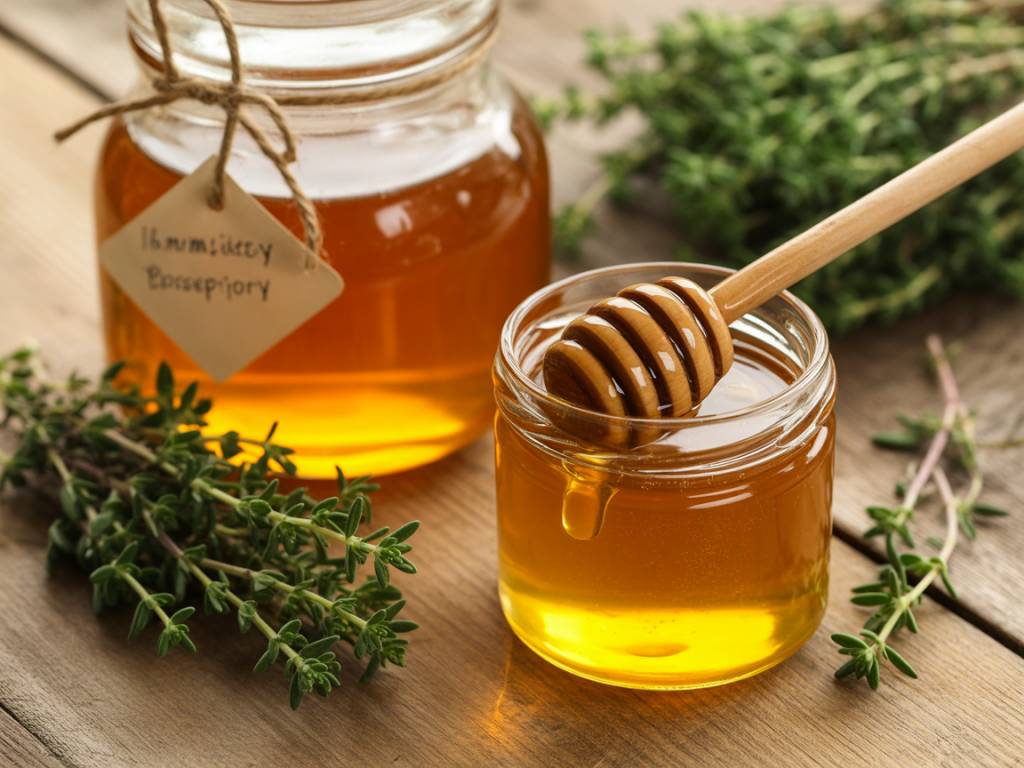
There’s a reason thyme honey has quietly become a staple in so many natural kitchens and home remedy cupboards. It’s fragrant, surprisingly powerful, and when it’s produced with care, it also supports bees and the ecosystems they pollinate.
If you already use thyme in your cooking or sip thyme herbal tea when you’re feeling under the weather, thyme honey is like the concentrated, spoonable version of that same plant power – with the soothing softness of a good raw honey.
What exactly is thyme honey?
Thyme honey is a monofloral honey: most of the nectar comes from thyme flowers rather than a mix of different plants. You’ll find it most often from regions where thyme grows abundantly and blooms generously: Mediterranean hillsides, dry rocky soils, organic herb farms.
Compared with a “classic” wildflower honey, good thyme honey tends to have:
- A more herbal, aromatic nose – think warm, resinous, slightly spicy notes.
- A deeper colour – from golden amber to a rich copper tone.
- A lingering taste – less “simple sweetness”, more complex and savoury.
Producers I work with often describe thyme as a “character plant”: bees love it, it’s incredibly fragrant, and when it dominates the landscape during flowering, the honey takes on that botanical signature quite clearly.
Why thyme honey is interesting for immunity
Let’s be honest: no honey is a magic shield against infections. But thyme honey does concentrate several useful compounds that can gently support your immune system and overall resilience.
Three points to remember:
- Raw honey in general offers small amounts of antioxidants (polyphenols), trace minerals, enzymes and antibacterial compounds.
- Thyme as a plant is rich in thymol and carvacrol, two aromatic molecules with antimicrobial and antioxidant properties (this is why thyme essential oil is so potent).
- Thyme honey sits somewhere in between: not as concentrated as the essential oil, but it can carry a “fingerprint” of thyme’s beneficial compounds into a gentle, food-like form you can use daily.
What does that mean in practice?
- Antioxidant support: Studies on herbal honeys (thyme, heather, manuka, etc.) show higher antioxidant capacity than many basic, blended supermarket honeys. Antioxidants help the body manage everyday oxidative stress, especially during winter or periods of fatigue.
- Antibacterial synergy: Raw honey’s natural acidity, low water content, and hydrogen peroxide production already make it hard for many microbes to thrive. Thyme-related compounds can add an extra layer of antimicrobial action, particularly against some bacteria responsible for throat or respiratory infections.
- Soothing comfort: Honey coats the throat, reduces irritation, and can help calm coughing. Several clinical trials (mostly with regular honey) found it as effective as some over-the-counter syrups for night-time cough in children over 1 year old.
Use it as a gentle everyday ally, not a stand-alone treatment. If you suspect a bacterial infection, fever, or persistent chest pain, medical advice comes first; thyme honey is a supplement to care, not a substitute.
Respiratory comfort: how thyme honey can help you breathe easier
Thyme has a long history in herbal medicine for the lungs: it’s used in herbal teas and syrups for “wet” coughs, congestion and sore throats. Thyme honey brings some of that tradition into an even more practical format.
Here’s how it can support your respiratory comfort:
- Softens irritated mucous membranes: The thick texture of honey forms a thin layer over the throat, calming the urge to cough, especially the dry, hacking type that keeps you awake at night.
- Helps manage mucus: Thyme has expectorant properties – it helps to “mobilise” mucus so you can clear it more easily. In honey form, you get a milder but still noticeable support, especially when combined with hot drinks.
- Supports upper respiratory defences: A spoonful of thyme honey dissolved slowly in the mouth gives prolonged contact with the throat area, where many respiratory infections start or linger.
From a very practical, kitchen-table point of view, here are a few ways I use thyme honey during cough and cold season:
- Straight from the spoon: 1 teaspoon, allowed to melt slowly in the mouth, up to several times a day for adults. For children over one year old, ½ to 1 teaspoon is usually enough.
- In warm herbal teas: Add thyme honey to a cup of:
- Thyme infusion (for a “double thyme” effect),
- Linden blossom (for relaxation and a soft, honeyed taste), or
- Lemon and ginger (for a more stimulating, decongestant drink).
- As a pre-sleep ritual: A small cup of warm water or herbal tea with 1 teaspoon of thyme honey, sipped slowly 30 minutes before bed, can reduce nocturnal coughing and dry throat at night.
Important reminder: honey is not recommended for children under 1 year because of the risk of infant botulism. For older children and adults, always adapt quantities and frequency to age, weight and overall health.
Daily immune support: realistic ways to use thyme honey
Rather than “saving” thyme honey for when you’re already sick, I prefer to integrate small amounts into everyday routines during autumn and winter. The goal: make it easy and enjoyable enough so that you actually stick to it.
Some realistic ideas:
- Morning spoon on an empty stomach: 1 teaspoon, followed by a glass of lukewarm water or an infusion. Simple, quick, and easy to remember.
- Switch your usual sweetener: Use thyme honey instead of white sugar in:
- Natural yoghurt or kefir,
- Porridge, muesli or overnight oats,
- Fruit salads with citrus, pear or roasted apples.
- Pair it with vitamin C–rich foods: Drizzle over:
- Fresh orange or grapefruit segments,
- A kiwi and pomegranate seed bowl, or
- A simple grated carrot and apple salad with lemon.
- Make a “winter jar”: In a clean jar, layer:
- Thin slices of organic lemon and/or ginger,
- Thyme honey to cover completely.
Leave 24 hours in the fridge. Use 1–2 teaspoons in hot water or herbal tea for a quick, ready-made winter drink.
Try to keep your daily total around 1–2 tablespoons maximum for an adult, including all sources of added sugars. If you have diabetes, insulin resistance or need to watch your carbohydrate intake closely, talk to your doctor or dietitian before adding honey routinely.
A simple thyme honey syrup for home use
If you like having a “house syrup” on hand for the first signs of a sore throat or an evening cough, this one is very simple and relies on ingredients you can easily source organically.
Ingredients (for a small jar)
- 150 g raw thyme honey
- 1 small handful dried organic thyme (or 3–4 fresh sprigs, well rinsed and dried)
- Juice of ½ organic lemon
- Optional: a few thin slices of fresh ginger
Method
- Pour the thyme honey into a small clean glass jar.
- Add the dried thyme (and ginger, if using).
- Mix gently with a clean spoon to coat the herbs with honey.
- Close and let infuse at room temperature for 24–48 hours, away from direct heat and light.
- After infusion, gently warm the closed jar in a bowl of lukewarm water (not hot) to make the honey more fluid, then strain through a fine sieve into a second clean jar.
- Add the lemon juice, stir, close and store in the fridge.
Use
- Adults: 1 teaspoon, up to 3 times a day when needed.
- Children over 1 year: ½ to 1 teaspoon once or twice a day.
Consume within 2–3 weeks, always using a clean spoon. If it ferments or develops off smells, discard.
How to choose a good thyme honey
Not all thyme honeys are created equal. The label, origin and production method will tell you a lot about its quality and its impact on bees and biodiversity.
When you’re in front of the shelf (or browsing online), check these points:
- Look for raw or minimally processed:
- Prefer “raw honey”, “unheated” or “cold extracted”.
- Avoid honeys that mention high-temperature pasteurisation, as heat can reduce enzymes and some volatile compounds.
- Check the botanical origin:
- The label should clearly mention “thyme honey” or “honey from thyme nectar”.
- Good producers often specify the variety (e.g. Thymus vulgaris) and the flowering area.
- Read the origin carefully:
- “Blend of EU and non-EU honeys” usually means a highly standardised industrial product with little traceability.
- Prefer “Product of [country]” or, even better, from a clearly identified region or beekeeper.
- Organic certification where possible:
- EU organic or equivalent labels set rules for hive placement (away from heavy pollution), limit synthetic treatments on bees, and ban most agricultural chemicals in the foraging area.
- It’s not a 100% guarantee, but it’s a strong baseline if you can’t buy directly from a trusted beekeeper.
- Texture is not a quality defect:
- If your thyme honey crystallises, that’s normal. Some floral sources crystallise faster than others.
- A very uniform, always-liquid texture can indicate heating or ultra-filtration, especially in cheap supermarket blends.
- Price as a clue:
- Real thyme honey is a niche product from a specific flowering period. If the price is suspiciously low, quality and bee welfare are unlikely to be the priority.
Whenever possible, buy from small or medium-scale beekeepers who can talk about their hives, their landscapes and their practices. A five-minute chat at a market can tell you more than a dozen labels.
Thyme honey and sustainable beekeeping: what’s behind the jar
Every jar of honey is the visible result of thousands of bee flights, a specific flowering window, and a beekeeper’s management choices. With thyme honey, the link to biodiversity is especially tangible, because wild thyme often grows in fragile, dry ecosystems.
Here’s what to look for if you want your thyme honey habit to support bees and landscapes, not deplete them.
- Hive location and forage diversity:
- Responsible beekeepers place hives in areas with abundant wild flowers or organic crops, not in monoculture deserts.
- Even if thyme is the main nectar source at flowering time, bees need a varied diet across the seasons.
- Limited and careful hive transport:
- Moving hives to follow thyme flowering is common, but constant long-distance transport stresses bees.
- Ask producers how often they move hives and over what distances.
- Moderate harvests:
- Ethical beekeepers leave enough honey for the colony’s own needs and only take the surplus.
- Excessive harvesting forces beekeepers to feed bees with sugar syrup, which is less nutritious and can weaken colonies over time.
- Limited chemical use in hives:
- Varroa mite treatment is unfortunately necessary almost everywhere today, but methods differ in toxicity.
- Organic and low-impact beekeepers favour organic acids and essential oil–based treatments over synthetic pesticides.
- Support for wild pollinators:
- Good beekeepers are usually very aware of the balance between hive density and local resources.
- High concentrations of managed hives in fragile environments can compete with wild bees for flowers, especially when forage is scarce.
If you have the chance to visit an apiary, observe:
- The surrounding landscape (diverse and flower-rich, or mostly bare and agricultural?).
- The number of hives per site (a smaller number, well spaced out, is generally better).
- The beekeeper’s attitude when talking about bee health, local plants, and long-term soil and flower management.
A thyme honey made from wild thyme on well-managed land, with realistic hive densities and careful harvesting, becomes much more than a simple sweetener. It’s a small, practical way to financially support the kind of agriculture and land management that leaves room for pollinators.
Integrating thyme honey into an everyday sustainable kitchen
To finish in a very down-to-earth way, how do you actually integrate thyme honey into your week so it doesn’t gather dust in the cupboard?
Here’s a sample “real life” use pattern that works well in a busy household:
- At breakfast:
- 1 teaspoon over natural yoghurt + oats + grated apple.
- Or stirred into a simple lemon and hot water, especially on cold mornings.
- At work or on the go:
- Keep a small jar or honey sticks in your desk drawer.
- Use ½ teaspoon in afternoon herbal tea instead of a sugary snack.
- In cooking:
- Drizzle over roasted carrots, parsnips or pumpkin, with olive oil, sea salt and thyme leaves.
- Use in a vinaigrette: 1 tsp thyme honey + 1 tsp mustard + 2 tbsp lemon juice + 4 tbsp olive oil + pinch of salt.
- For “first symptoms” care:
- As soon as a sore throat or tickly cough appears, switch your usual sweetener to thyme honey.
- Take 1 teaspoon before bed, straight or in a herbal tea.
The aim is not perfection, but gentle, consistent habits that support your health while respecting bees and biodiversity.
Choose a well-made thyme honey, give it a dedicated spot in your kitchen, and let it become one of those small, reliable allies you reach for throughout the colder months – both for your own comfort and for the landscapes that make that spoonful possible.