Why an organic garden makes sense, even on a tiny balcony
Think your space is too small to grow anything worthwhile? If you have a balcony, a windowsill or a single sunny corner, you already have enough to start a small organic garden.
Beyond the pleasure of picking your own herbs, a tiny organic garden means:
- Fewer pesticide residues in your food
- Zero transport from field to plate (you just walk to the balcony)
- Less packaging, less plastic, less waste
- A better understanding of how food grows – which often changes the way we shop and cook
And the bonus: you can start small, with almost no equipment, and grow your garden step by step. Let’s break it down in a way that fits real life – and small spaces.
Step one: understand your space (light, wind, water)
Before buying seeds or pots, take two days to simply observe your space. This is the “soil test” of balcony gardening.
1. How much light do you really get?
- 6+ hours of direct sun: You can grow almost anything: tomatoes, peppers, strawberries, most herbs.
- 3–5 hours of partial sun: Perfect for leafy greens (lettuces, spinach, rocket), spring onions, many herbs.
- Very little direct sun: Focus on shade-tolerant herbs (mint, parsley, chives), microgreens and salad mixes.
Note when the sun hits your balcony or window: morning, midday, late afternoon? This will guide your plant choices.
2. How exposed is your balcony to wind?
Wind dries out pots very quickly and can stress delicate plants. Ask yourself:
- Does the wind regularly knock over light objects?
- Are there strong gusts between buildings?
If yes, you’ll need:
- Heavier pots (terracotta or large planters) for the tallest plants
- Simple windbreaks: bamboo screens, a wooden trellis, or even a row of sturdier plants protecting the rest
3. Where will your water come from?
Carrying a watering can through a flat several times a day quickly becomes tiring. To make this sustainable:
- Place your main pots as close as possible to your water source
- Use trays under pots to catch runoff and reduce waste
- Consider a small watering can with a long spout that you can keep on the balcony
Once you’ve noted light, wind and water access, you can choose plants that will actually thrive – not struggle.
Step two: choose the right containers (and reuse what you have)
In a small organic garden, the container is your “field”. Its size and quality will directly impact your harvest.
What you can use as containers
- Classic pots (terracotta or recycled plastic) in 10–30 cm diameter
- Window boxes for railings or sills
- Vertical fabric pockets on a wall or railing
- Reused containers: food-grade buckets, wooden crates, old metal tins (with drainage holes)
Minimum sizes for common balcony crops
- Herbs (basil, parsley, thyme, mint): 15–20 cm deep pot
- Salad greens (lettuce, rocket, spinach): window box or shallow crate, 15 cm deep
- Cherry tomatoes: one plant per 20–30 cm deep pot
- Radishes: any container 10–15 cm deep
- Strawberries: hanging baskets or 15–20 cm pots
Essential detail: drainage
Whatever container you choose, it must have holes at the bottom. No holes = roots rotting, fungi, and a short plant life. If you reuse boxes or tins, make several small holes with a drill or strong nail, and add a shallow tray underneath to catch excess water.
Step three: choose an organic growing medium that works
This is where the “organic” part really starts. Healthy soil is your best tool for strong, resilient plants.
Look for these mentions on bagged soil:
- “Organic” or “certified organic” with a clear label (e.g. Soil Association, EU Organic logo, or another recognised national label)
- “Peat-free” to protect peatlands and reduce the carbon footprint of your garden
- “For vegetables and herbs” (avoid mixes intended only for decorative plants)
Simple mix for balcony vegetables
If you want to improve store-bought compost, you can mix:
- 2 parts organic vegetable compost
- 1 part coarser material (coco coir or fine bark) for drainage
- A handful of mature compost or worm castings (if you have access to a community compost or wormery)
Fill your containers almost to the top, leaving 2–3 cm free so that watering doesn’t overflow.
Step four: start with beginner-friendly organic plants
Not all plants are equally forgiving. For a first small organic garden, focus on varieties that give quick, visible results and survive the occasional mistake.
Herbs: your best allies in tiny spaces
- Basil: loves warmth and sun, perfect near a south-facing window. Use in salads, pasta, pesto.
- Parsley: slower to start, but very productive. Great for finishing soups, grains, egg dishes.
- Chives: easy, regrows after each cut. Ideal on omelettes, potatoes, dips.
- Mint: very hardy, but invasive – keep it in its own pot. For teas, infused water, tabbouleh.
- Thyme and rosemary: like sun and slightly drier soil. Perfect with roasted vegetables and pulses.
Leafy greens: maximum harvest per square centimetre
- Lettuce mixes (cut-and-come-again): sow densely in a box, cut leaves with scissors, let them regrow.
- Rocket: grows fast, slightly spicy, great for sandwiches and pasta.
- Spinach or Asian greens (pak choi, mizuna): like cooler temperatures and partial shade.
“Fun” crops for a sunny balcony
- Cherry tomatoes: choose compact, balcony-friendly varieties. One plant can give you dozens of tomatoes.
- Radishes: from seed to harvest in about 4 weeks. Perfect to learn how seeds behave.
- Strawberries: ideal in hanging baskets. Children (and adults) love picking them.
Seeds or seedlings?
Both work, but for a first trial:
- Use organic seedlings (small plants) for tomatoes, strawberries, rosemary and thyme. It saves you weeks.
- Sow organic seeds for salads, rocket, radishes, basil and coriander.
Look for certified organic seed brands or local organic nurseries. The organic label guarantees that the plants have not been treated with synthetic pesticides or fertilisers during their production.
Step five: how to plant correctly in pots
Planting is simple, but a few details make a big difference to your harvest.
For seedlings (small plants)
- Fill your pot with moist organic compost, leaving a small hole in the centre.
- Gently remove the plant from its nursery pot, holding it by the base of the stem.
- Place it in the hole so that the top of the root ball is level with the surface.
- Backfill with compost, press lightly around the stem to stabilise.
- Water slowly until water emerges from the drainage holes.
For seeds
- Sow thinly on the surface of moist compost.
- Cover with a thin layer of compost: as thick as the seed itself (very thin for salads, slightly more for radishes).
- Water gently with a fine rose or spray bottle to avoid displacing seeds.
- Keep the soil slightly moist until germination (generally 3–14 days depending on the species).
For cut-and-come-again salads, do not worry if the sowing is a little dense – you will thin them by eating them.
Caring for your mini-garden: water, feed, harvest
Good news: small organic gardens require short but regular attention. Think “5–10 minutes a day” rather than big weekend sessions.
Watering: the key to success on balconies
- Frequency: in summer, usually once a day for small pots, every two days for larger ones. In cooler months, reduce.
- Test with your finger: if the top 2–3 cm are dry, it’s time to water.
- Water at the base of the plants, not on the leaves, preferably in the morning.
Terracotta pots dry out faster than plastic ones, and hanging baskets dry out faster than floor pots. Adjust accordingly.
Feeding plants organically
In pots, nutrients are limited. To keep your garden productive:
- Add a little organic slow-release fertiliser (vegetable-based pellets) at planting.
- Every 3–4 weeks, water with a diluted organic liquid feed (such as nettle, seaweed or plant-based fertiliser).
- If you drink coffee, you can occasionally mix a very small amount of used coffee grounds into the surface soil for hungry plants like tomatoes – but not more than a thin sprinkle.
Harvesting often = more growth
Counter-intuitive but true: the more you harvest correctly, the more your plants produce.
- Herbs: snip stems above a pair of leaves, never removing more than one-third of the plant at once.
- Salads: cut outer leaves with scissors, letting the centre grow back.
- Tomatoes and strawberries: pick fruits when fully coloured. Leaving ripe fruit on the plant slows new production.
Make it a habit: every time you cook, ask yourself, “What could I pick on the balcony to add freshness?”
Keeping it organic: simple pest and disease management
Balcony gardens, especially in cities, often have fewer pests than large ground gardens. But some visitors are inevitable. The goal in organic gardening is not perfection, but balance.
Common balcony pests and what to do
- Aphids (tiny green/black insects on soft stems): spray with a mix of water and a few drops of mild organic soap, or simply rinse the stems under a gentle stream of water. Encourage ladybirds if you have access to a shared garden.
- Whiteflies (tiny white insects flying when you touch the plant): use yellow sticky traps and the same mild soap spray on the underside of leaves.
- Slugs and snails (in ground-level or very damp areas): raise pots off the ground, use copper tape around pots, avoid leaving wet debris nearby.
Strengthening plants naturally
- Do not overcrowd pots: good air circulation prevents fungi.
- Avoid constantly wet leaves; water the soil instead.
- Use healthy, certified organic seeds and seedlings – they are often more resistant.
If a plant really struggles despite your care, do not hesitate to replace it. In a small garden, every pot counts. It is better to restart with a fresh, healthy plant than to keep a sick one that may spread problems.
Making space: vertical and creative solutions
Even the smallest balcony can host more plants than you think once you start using the height.
Vertical ideas
- Wall planters or fabric pockets for herbs and strawberries
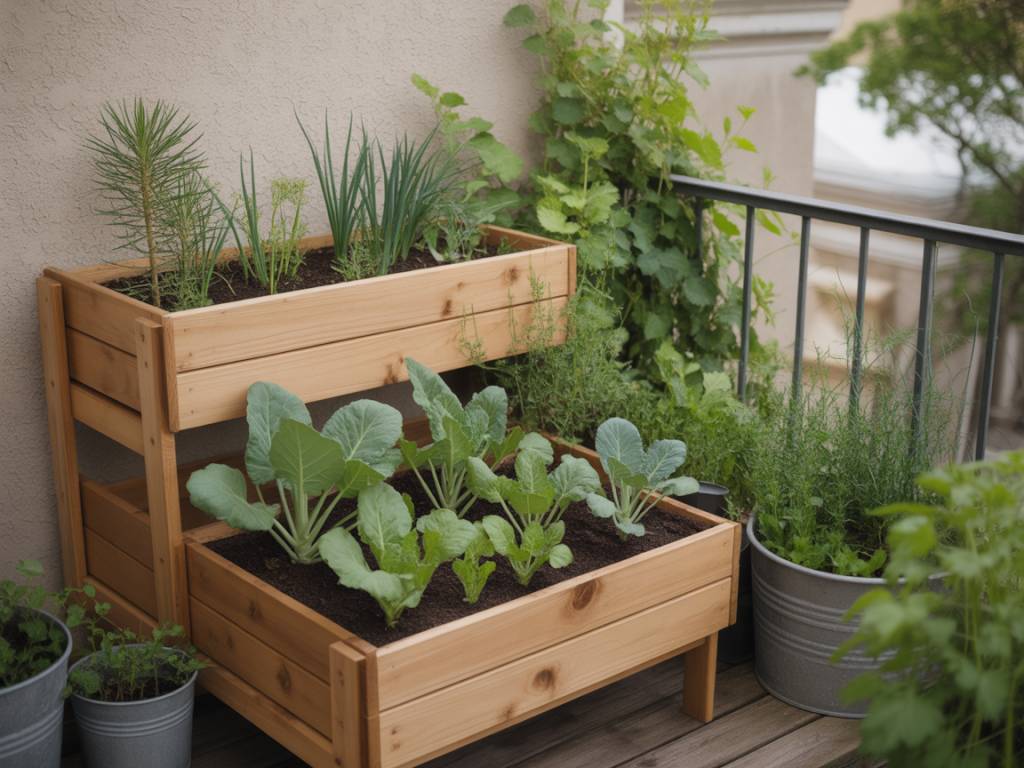
- A simple wooden or metal shelf against the wall to stack pots
- Hanging baskets for trailing cherry tomatoes, strawberries or herbs
- Rail planters on balcony railings for salads and flowers that attract pollinators
Safety reminder: check the weight your balcony can handle, and fix any railing planters securely. Wet soil is heavy; several large containers filled with compost and water can add significant load.
Compact layout that works well
- Tallest plants (tomatoes, beans on a small trellis) at the back, near the wall
- Medium pots (herbs, bushy plants) in the middle
- Low boxes (salads, radishes) at the front or on the railing
- Hanging baskets above eye level to free floor space
This way, each plant gets light without shading the others, and you can still move around easily.
From balcony to plate: how to use your harvest daily
A tiny garden becomes truly satisfying when it starts shaping your everyday cooking. The idea is not to replace all your shopping, but to upgrade what you already eat.
Everyday ways to use balcony herbs
- Chop chives and parsley over scrambled eggs or omelettes.
- Add a handful of fresh basil to any pasta dish or grain salad.
- Use mint in water with lemon slices, or in simple fruit salads.
- Sprinkle thyme and rosemary on roasted root vegetables or chickpeas before baking.
Fast balcony-to-table recipes
- 5-minute balcony salad: mix cut-and-come-again lettuce, rocket, a few cherry tomatoes and herbs. Add olive oil, lemon juice, salt, pepper.
- Herb oil for the week: blend a large handful of mixed herbs (basil, parsley, chives) with olive oil and a pinch of salt. Keep in the fridge and drizzle on everything.
- Simple herb omelette: whisk eggs with chopped balcony herbs, a spoon of milk or plant drink, salt and pepper; cook gently in a pan.
Having herbs and greens at arm’s length encourages you to season with plants instead of salt or ready-made sauces – which is good news for both health and flavour.
Growing habits, not just plants
A balcony garden does more than provide a few tomatoes. It gently changes the way you buy, cook and store food.
What many balcony gardeners notice after a few months
- You read labels differently and seek out more organic produce.
- You waste fewer herbs and salad bags, because you pick only what you need.
- You plan meals around what is ready on the balcony (“There’s a lot of rocket, let’s make a pesto tonight.”).
- You become more sensitive to seasons and weather, even in the middle of the city.
And most importantly: you realise that “not having a garden” does not mean “having no connection with how food grows”. A few pots, some good soil, a handful of seeds and regular attention are enough to build that link – and to upgrade your everyday cooking with something homegrown, fresh and truly organic.