


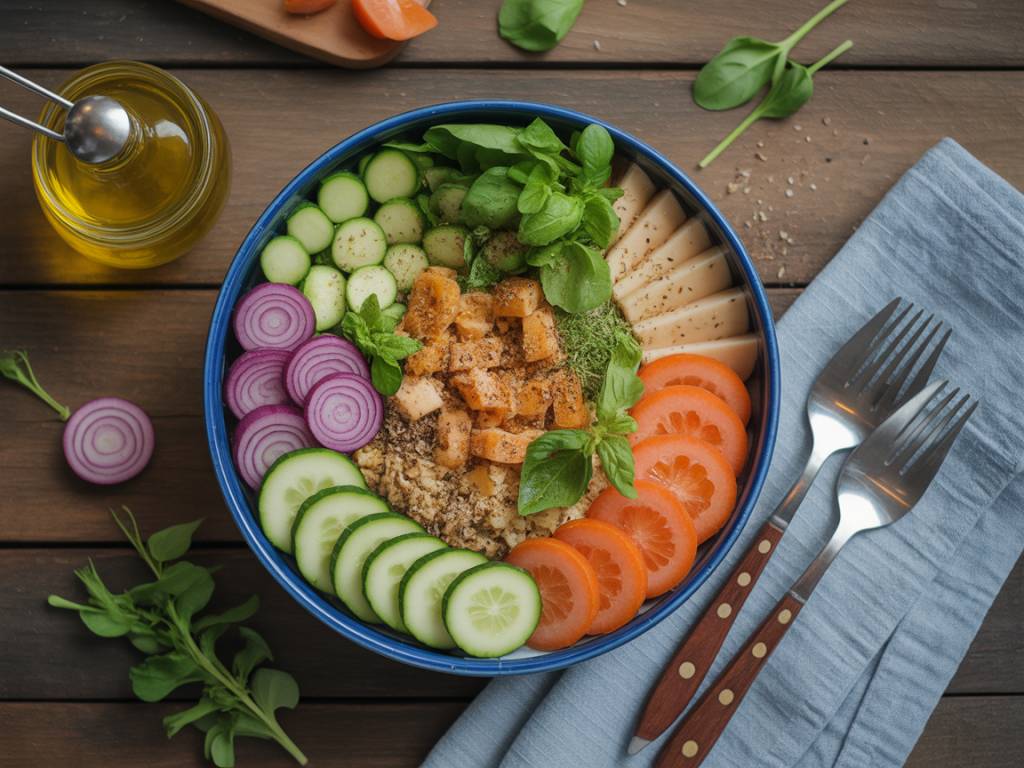
Some evenings, cooking a “proper meal” feels like climbing a mountain. That’s where complete, balanced bowls come in: one bowl, a few smart building blocks, seasonal ingredients, and you’re eating something colourful, nourishing and satisfying in under 20 minutes.
In this article, we’ll break down how to build an everyday bowl that actually keeps you full, how to adapt it to what’s in season, and how to organise your shopping and prep so this becomes your simplest healthy default, not just a pretty idea on Pinterest.
What is a complete, balanced bowl?
A balanced bowl isn’t just “a bit of everything in a dish”. It follows a simple structure so you can assemble it almost on autopilot and still cover your main nutritional needs.
Think of your bowl as four quarters plus a topping:
- ½ of the bowl – Vegetables and fruit: mostly seasonal, ideally organic, raw and/or cooked, plenty of colours.
- ¼ of the bowl – Whole grains or starchy veg: brown rice, quinoa, oats, buckwheat, wholegrain pasta, potatoes, sweet potatoes… this is your slow energy.
- ¼ of the bowl – Protein: beans, lentils, tofu, tempeh, eggs, dairy, fish or quality meat depending on your diet.
- 1 small “corner” – Good fats: nuts, seeds, avocado, cold-pressed oils, oily fish.
- On top – Flavour boosters: herbs, ferments, sauces, spices, citrus.
Once you know this ratio, you can stop counting grams or macros. Just look at your bowl: if half of it is plants, a quarter grains or starchy veg, a quarter protein and a touch of healthy fat, you’re already far ahead of the average takeaway.
Why seasonal ingredients make better bowls
Could you make the same bowl with cherry tomatoes in January and asparagus in October? Yes. Will it be as tasty, nourishing or sustainable? Not really.
Choosing seasonal produce brings three big advantages:
- More flavour: picked closer to ripeness instead of travelling for days, often refrigerated and gas-ripened.
- Better nutrition density: shorter time between harvest and plate usually means fewer vitamin losses, especially for vitamin C and delicate antioxidants.
- Lower footprint (and usually lower price): seasonal, local-ish produce tends to require less heating, transport and packaging.
At the supermarket or market, it’s not always obvious what’s in season. A simple check:
- Look for origin labels: UK, nearby EU countries, or your local region in season; far-flung origins are often a sign of off-season imports.
- Compare prices over the year: when courgettes or berries suddenly get cheaper, that’s usually peak season.
- Use the store itself as a calendar: big, generous displays and promotions often follow seasonal gluts.
Organic labels such as Soil Association or the EU organic leaf guarantee no synthetic pesticides or fertilisers and stricter rules on biodiversity and animal welfare. For produce you eat often (leafy greens, apples, berries), choosing organic when you can is a simple way to reduce exposure to residues and support more sustainable systems.
Seasonal bowl blueprints (you can mix and match)
Instead of fixed recipes, think in flexible “blueprints” that you can adapt to what you find in your veg box or at the market.
Here are a few ideas by season. Use them as templates and swap ingredients within the same family.
Spring refresh bowl
Perfect when the first fresh greens appear and we’re craving lighter food after winter stews.
- Base veg (½ bowl): blanched asparagus, peas or broad beans, thinly sliced radishes, baby spinach or rocket.
- Grain (¼ bowl): pearl barley, quinoa or new potatoes, still slightly warm.
- Protein (¼ bowl): soft-boiled egg, crumbled feta, or cooked lentils.
- Fats: toasted pumpkin seeds + drizzle of extra virgin olive oil.
- Flavour boosters: lemon zest, chopped fresh herbs (mint, parsley, chives), a spoonful of plain yoghurt as a “sauce”.
Time-saver tip: cook a batch of barley or new potatoes at the weekend, keep in an airtight box in the fridge, and reheat quickly with a splash of water or use cold in salads.
Summer rainbow bowl
Summer is the easiest moment to fill half a bowl with colourful plants without even trying.
- Base veg (½ bowl): mixed tomatoes, cucumber, grilled courgette or aubergine, sweetcorn, shredded lettuce.
- Grain (¼ bowl): cold brown rice, wholegrain couscous or bulgur.
- Protein (¼ bowl): chickpeas, grilled halloumi, marinated tofu, or leftovers from a roasted chicken.
- Fats: a few olives, tahini sauce, or a quarter of an avocado.
- Flavour boosters: fresh basil, oregano, a splash of apple cider vinegar or balsamic, black pepper.
Batch-cook idea: roast a big tray of summer veg (courgettes, peppers, onions, aubergines) with olive oil and garlic. Keep it in the fridge for 3–4 days and use it to build bowls, fill wraps, or top toast.
Autumn harvest bowl
When the days get cooler, bowls can become a bit more comforting while staying balanced.
- Base veg (½ bowl): roasted squash or pumpkin, sautéed mushrooms, shredded cabbage, grated raw beetroot or carrot.
- Grain (¼ bowl): quinoa, buckwheat or wholemeal pasta.
- Protein (¼ bowl): lentil stew, baked tofu, or slow-cooked beans.
- Fats: walnuts or hazelnuts, a knob of good butter or a drizzle of rapeseed oil.
- Flavour boosters: fresh thyme, rosemary, a spoon of sauerkraut or pickled onions for acidity.
Zero-waste angle: keep squash seeds, rinse them, dry them and roast them with a little oil and salt. They make a crunchy topping rich in zinc and healthy fats.
Winter warming bowl
Winter bowls rely more on storage veg, pulses and grains, with a few fresh greens from the tunnel or windowsill.
- Base veg (½ bowl): roasted carrots, parsnips, celeriac or turnips, plus some steamed or sautéed kale, cabbage or leeks.
- Grain (¼ bowl): oats in a savoury porridge, barley, or brown rice.
- Protein (¼ bowl): beans in tomato sauce, dhal, or tinned oily fish like sardines or mackerel.
- Fats: flaxseed or hempseed, grated cheese, ghee, or olive oil.
- Flavour boosters: warming spices (cumin, smoked paprika, curry blends), lemon juice, chopped garlic or ginger.
Skillet shortcut: reheat yesterday’s roasted root vegetables in a pan with a spoonful of oil and spices, add cooked beans and a splash of water, and you’ve got a five-minute base for your bowl.
The 10-minute “formula” for any bowl
On a busy weekday, you don’t have time to think. Use this step-by-step and plug in whatever you have.
- Step 1 – Choose your grain or starch: take it from the fridge (batch-cooked) or put on a quick-cook option (couscous, quinoa, fresh pasta, oats).
- Step 2 – Add at least two veg: one raw (tomato, grated carrot, salad leaves) and one cooked (roasted veg leftovers, steamed broccoli, frozen peas).
- Step 3 – Pick your protein: open a jar of beans, slice leftover meat or fish, fry some tofu, crack two eggs in a pan…
- Step 4 – Add fats: handful of nuts or seeds, a spoon of nut butter, a glug of good oil.
- Step 5 – Finish with flavour: something acidic (lemon, vinegar), something aromatic (herbs, spices), maybe something fermented (kimchi, sauerkraut, live yoghurt).
If your pantry and fridge are reasonably stocked, this process takes more time to read than to apply.
Shopping smart: what to buy organic, what to prioritise
In an ideal world, everything would be local, small-scale and organic. In real life, we juggle budgets, time and what’s actually on the shelf. Here are some simple rules I use when shopping for bowl ingredients.
For vegetables and fruit:
- Prioritise organic for thin-skinned produce you eat regularly (leafy greens, apples, berries, grapes, peppers).
- Be more flexible on thick-skinned veg (onions, squash, bananas), where residues are typically lower.
- When organic is not an option, choose seasonal, EU/UK origin, and wash well; peeling can help for some produce, though you lose some fibre.
For grains and pulses:
- Look for organic labels (Soil Association, EU leaf) on oats, wheat, rice and lentils if your budget allows, as these crops can be treated post-harvest.
- Buy in bulk from reputable brands or shops with good turnover to avoid stale products.
- Rinse pulses and grains before cooking to reduce dust and some residues.
For animal products (if you eat them):
- Prioritise quality over quantity: smaller portions of better meat, fish and dairy within your bowls.
- Choose labels that guarantee higher welfare and outdoor access where possible.
- For fish, favour smaller oily fish (sardines, mackerel), often lower in contaminants and higher in omega-3.
Batch cooking and storage: how to always be “bowl-ready”
Balanced bowls become really easy when the “slow” components are already cooked and waiting in the fridge or freezer.
On a quiet moment once or twice a week, prepare:
- 1–2 grains: a big pot of brown rice, quinoa, barley or bulgur. Cool quickly, then store in airtight containers in the fridge (3–4 days) or freezer (portioned).
- 1 pot of pulses: lentil soup, chickpeas, black beans. They can be used warm as a stew or cold in salads.
- 1 tray of roasted veg: whatever is seasonal, cut in similar sizes, tossed with oil and salt, roasted until golden.
- A jar of sauce: tahini-lemon, yoghurt-herb, simple vinaigrette, or a homemade pesto.
- Washed salad leaves and herbs: dry them well (a salad spinner helps) and store in a box lined with a cloth or paper towel.
Once these are ready, you’re genuinely five to ten minutes away from a satisfying bowl, even when you think you have “nothing” in the house.
How to adjust bowls for different needs
Not everyone has the same appetite or health goals. The bowl structure is flexible enough to adapt without overthinking.
If you’re very active or often hungry:
- Increase the grain or starchy veg portion to roughly a third of the bowl.
- Add a bit more healthy fat (extra nuts, seeds, avocado) for sustained energy.
- Use protein-rich grains like quinoa or buckwheat more often.
If you’re watching blood sugar or aiming for weight loss:
- Keep at least half the bowl as non-starchy veg (greens, crucifers, salads).
- Choose whole grains and chew properly; avoid turning bowls into “hidden pasta mountains”.
- Make sure you have a satisfying protein portion (beans, lentils, tofu, fish, eggs) to avoid snacking later.
If you eat plant-based:
- Combine different plant proteins across the day (pulses, whole grains, nuts, seeds, soy) to cover your amino acid needs.
- Use calcium-enriched plant milks or tofu where possible.
- Don’t forget vitamin B12 supplements or fortified foods; it won’t come from the bowl ingredients alone.
Flavour first: making healthy bowls crave-worthy
A bowl can be nutritionally perfect and still feel a bit sad if it lacks texture, acidity or contrast. A few small details change everything.
- Play with textures: mix something soft (roasted veg, grains) with something crunchy (raw veg, seeds, nuts, toasted crumbs).
- Add acidity: a squeeze of lemon, a spoon of vinegar, pickles or ferments brighten the whole bowl.
- Use herbs generously: parsley, coriander, basil, dill, mint… treat them like salad leaves rather than decoration.
- Spice wisely: one or two spices per bowl is enough; for example cumin + coriander, or smoked paprika + chilli.
- Don’t fear salt – in moderation: especially if most of your bowl is fresh, home-cooked ingredients, a pinch of good salt helps flavours pop and reduces the temptation to add ultra-processed sauces.
If your bowl tastes “flat”, ask yourself: do I have enough acid? Enough salt? Enough crunch? Adjust those before blaming the vegetables.
Your next step: set yourself up for easy bowls this week
To make this article useful beyond today, pick one small action you can do in the next 48 hours. For example:
- Cook a big pot of one grain and one pulse.
- Roast a tray of whatever seasonal veg you can find.
- Prepare one simple sauce you like and keep it in the fridge.
- Write a mini list of three bowl combinations you want to try this week, based on what’s in season near you.
Balanced bowls are not a trend; they’re just a very practical way to bring together seasonal ingredients, minimise waste, and feed yourself (and the people you love) well, even on the busiest days. Once the structure becomes second nature, you’ll find you can open the fridge, look at what’s there, and build a complete meal in a single bowl without even following a recipe.