


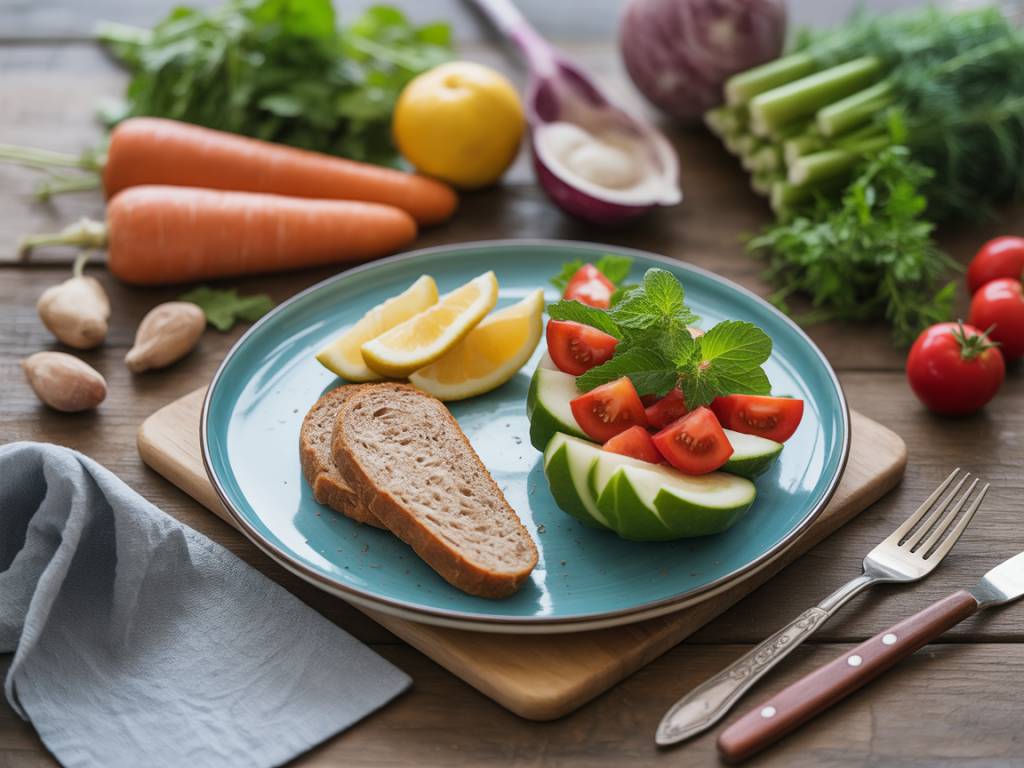
Why “eating healthier” often feels harder than it should
Changing how you eat looks simple sur le papier: more vegetables, less ultra-processed food, maybe cook a bit more at home. In real life, it often turns into frustration, guilt, and a fridge full of good intentions gone slimy at the back of the drawer.
In my work as a sustainable food consultant, I see the same patterns again and again. People are highly motivated, they care, they spend more on “healthy” and organic… and yet, nothing really sticks. Or worse, they end up eating less well than before because they are tired, overwhelmed and permanently “on a diet”.
Let’s look at the most common mistakes I see when people “decide to eat healthier” — and more importantly, how to correct them gently, without all-or-nothing thinking, without guilt, and without complicating your life.
Mistake 1: Changing everything at once
On Sunday night, the motivation is sky-high. You decide: no more sugar, no bread, no pasta, no alcohol, only organic vegetables, homemade meals every day, and you’ll start soaking chickpeas like a professional chef.
By Thursday, you’re eating crisps for dinner over the sink.
This “big bang” approach rarely works, not because you lack willpower, but because it ignores how habits are formed: slowly, with repetition, in a real life where work, kids, fatigue and last-minute invitations exist.
Gentle correction: one change at a time (really)
Pick one tiny, boring change you can keep even on a bad day. For example:
- Add one portion of vegetables to either lunch or dinner every day.
- Switch your usual afternoon biscuit to a piece of fruit three days a week.
- Replace one take-away per week with a simple home-cooked meal (omelette, soup, salad… nothing fancy).
Give yourself two to four weeks to stabilise that habit before adding another one. Think of it as layering: small, sustainable changes stacked over time are much more powerful than a heroic but short-lived “perfect week”.
Mistake 2: Making it too complicated (and too “Instagrammable”)
Another classic: deciding that “eating healthier” means you now have to cook like a plant-based chef on social media. Overnight, your meals must be colourful Buddha bowls, homemade dips, fermented vegetables, nut butters and intricate smoothies.
The result? You spend half your Sunday prepping, you’re exhausted… and by Wednesday, you don’t want to look at a chickpea ever again.
Gentle correction: master a handful of “boring but brilliant” meals
Healthy eating is not about impressive recipes; it’s about what you can cook on a Tuesday night when you’re tired and hungry. Aim to build a tiny repertoire of 5–7 “default” meals:
- One-pan roasted vegetables + protein (tofu, beans, chicken, fish) + olive oil.
- Big salad + something warm (lentils, boiled eggs, leftover roasted veg, canned fish).
- Basic soup (onion + any veg + stock) with wholegrain bread and cheese or hummus.
- Omelette or frittata with leftover vegetables and herbs.
- Stir-fry with frozen veg + noodles or brown rice + soy sauce, ginger, garlic.
These meals don’t need to be pretty. They need to be fast, satisfying, and based on simple, minimally processed ingredients. Once these are on autopilot, you can play with more creative recipes when you have time and energy.
Mistake 3: Throwing everything “unhealthy” in the bin
On Monday morning, you ceremoniously empty your cupboards: biscuits, chocolate, crisps, sugary cereals… all in the bin. It feels like a fresh start. Until reality hits.
A stressful day at work, a bad night’s sleep, a late train. You want something sweet, now. But you’ve created a famine zone at home. So you end up eating two industrial muffins from the petrol station and feeling awful about it.
Gentle correction: upgrade, don’t eradicate
Instead of banning, think in terms of better versions and portion control:
- Keep some “treat foods” at home, but choose slightly better options (dark chocolate instead of sugary bars, good-quality crisps with simple ingredients instead of flavoured ultra-processed ones).
- Use smaller bowls and plates for snacks; we eat a lot with our eyes.
- Create “planned treats”: decide in advance you’ll have dessert on Friday night or a pastry on Sunday morning. Anticipated pleasure is often more satisfying than impulse eating.
From a sustainability perspective, throwing away a bag of biscuits doesn’t make your diet more virtuous. Finish what you have, then gradually buy less or choose products with shorter ingredient lists, organic labels or fair-trade certifications.
Mistake 4: Relying only on motivation (and ignoring logistics)
“We’ll just eat more vegetables” is a beautiful idea. But if your fridge is empty, your knives are blunt and you’re getting home at 8 pm, it’s very hard to make it happen consistently.
Healthy eating is highly logistical: planning, shopping, storage, basic organisation at home. Motivation is the spark; systems keep the fire going.
Gentle correction: build two or three simple systems
You don’t need full meal prep with colour-coded boxes. Start with tiny structural changes that make the “healthy choice” the easiest one:
- Repeat your shopping list: Create a base list on your phone with your weekly staples (vegetables, fruit, whole grains, pulses, eggs, yoghurt, nuts). Reuse it every week instead of starting from zero.
- Pre-wash key items: When you come back from the market or shop, wash and dry a few “grab and eat” items (carrots, cherry tomatoes, grapes) and store them in visible containers.
- Freeze smart: Keep frozen vegetables, herbs, berries and bread slices. They are often frozen at peak ripeness, and they’re life-saving on busy nights.
- Equip your kitchen minimally: A good knife, a chopping board, a large pan and a baking tray are often enough to cook 80% of everyday meals.
If you regularly fail at your new habits, don’t blame yourself first. Check your logistics: did you have the ingredients, the time, the tools? Adjust the system, not your self-esteem.
Mistake 5: Demonising whole food groups
Carbs are evil. Fat is evil. Gluten is evil. Dairy is evil. Depending on the week, someone is trying to convince you that an entire group of foods is the enemy.
When you’re starting to eat healthier, going “no carb” or “no fat” can feel like a shortcut. In reality, most people end up with unbalanced plates, intense cravings, and a very tense relationship with food.
Gentle correction: think balance, not bans
Instead of eliminating, work on proportions and quality:
- Carbohydrates: Keep them on your plate, but favour whole grains (brown rice, whole-wheat pasta, oats, quinoa) and reduce ultra-processed products (white toast bread, sugary cereals, pastries every day).
- Fats: Don’t fear them; they’re essential. Prioritise olive oil, rapeseed oil, nuts, seeds, avocado, oily fish. Reduce deep-fried foods and industrial snacks high in trans fats.
- Animal products: You don’t have to become vegan overnight. Start with one or two plant-based meals a week using pulses (lentils, chickpeas, beans), while choosing better-quality animal products on the other days (organic, free-range, local when possible).
If you suspect a real intolerance (gluten, lactose…), consult a health professional before cutting entire categories. Self-diagnosed restrictions can create deficiencies and stress for nothing.
Mistake 6: Ignoring satiety and focusing only on “healthiness”
A lunch of salad leaves, cucumber and two cherry tomatoes might look very “clean” on a photo… but if you’re starving two hours later, it’s not a functional meal.
When starting to “eat better”, many people shrink their portions drastically or remove key elements (protein, fats, carbs) and then blame their lack of willpower when they end up raiding the kitchen later.
Gentle correction: build satisfying plates
A balanced meal should keep you full for 3–4 hours. A simple rule of thumb for a main meal:
- ½ of the plate: vegetables (raw, cooked, mixed, organic when possible).
- ¼ of the plate: protein (pulses, eggs, tofu, fish, poultry, etc.).
- ¼ of the plate: whole grains or starchy veg (brown rice, quinoa, whole pasta, potatoes, sweet potatoes).
- + 1–2 tablespoons of fat: olive oil, nuts, seeds, good-quality cheese, etc.
This structure is flexible, but it helps to check quickly: “Did I include enough protein and fat to feel full? Or did I make a ‘diet salad’ that will leave me hungry soon?” Satiety is not the enemy of healthy eating; it is its ally.
Mistake 7: Letting “healthy” labels replace real reading
“Light”, “low-fat”, “high-protein”, “natural”, “with whole grains”… The supermarket shelves are full of promises. Many people starting to eat healthier simply swap their usual products for these “health-washed” versions, thinking they’ve done their job.
But a low-fat yoghurt full of sugar and additives is not necessarily a better choice than a plain, full-fat yoghurt with two ingredients (milk + ferments), ideally organic.
Gentle correction: shorten the ingredient list
When you buy packaged foods, you don’t need a degree in nutrition. Focus on three simple checks:
- Number of ingredients: the shorter, the better, especially for everyday products (bread, yoghurt, tomato sauce…).
- Recognisable ingredients: you should be able to picture most of them (tomatoes, olive oil, salt), not a long list of additives and sweeteners.
- Labels: organic and fair-trade labels can guide you towards products with fewer pesticides and better farming practices, but they don’t replace reading the list. Organic ultra-processed food is still ultra-processed.
If you have to choose one thing to upgrade first, start with what you eat every day: your breakfast cereal, your bread, your oil, your dairy or plant-based alternatives. Improving these “daily basics” has more impact than obsessing over the occasional dessert.
Mistake 8: Forgetting about pleasure
Healthy eating sometimes gets presented as a punishment: plain chicken breast, steamed broccoli, no salt, no sauce, no wine, no fun. It’s not surprising that people “fall off the wagon” if the wagon is joyless.
From a sustainability perspective, pleasure is a crucial ingredient: if you don’t enjoy what you eat, you won’t keep those habits, and you’ll waste food, time and energy.
Gentle correction: build meals you actually look forward to
Ask yourself honestly: “Would I be happy to eat this three times this month?” If the answer is no, tweak your plan:
- Add flavour with herbs, spices, garlic, lemon, good-quality mustard, tahini, miso. These are simple, powerful tools to transform basic ingredients.
- Allow small indulgences inside meals: a little grated strong cheese on vegetables, a drizzle of good olive oil, a square of dark chocolate with your afternoon tea.
- Cook in bigger batches of dishes you love (a hearty lentil stew, a vegetable curry, a baked pasta with lots of veg) and freeze portions. Future-you will be very grateful.
Pleasure is not an optional extra; it’s a built-in part of a way of eating you can keep for years, not just for three weeks in January.
Mistake 9: Expecting perfection instead of progress
One “bad” meal, and the internal dialogue starts: “I’ve ruined everything, I might as well give up.” This all-or-nothing thinking is probably the biggest obstacle I see when people try to eat healthier.
But food, like life, is messy. There will be birthday cakes, late-night pizzas, train-station sandwiches and days when the only vegetable you eat is the tomato slice in your burger.
Gentle correction: adopt the “80/20” lens
Try to think in terms of trends, not isolated moments:
- If 80% of your meals are based on real, minimally processed foods, rich in plants, with reasonable portions, you already have a very solid foundation.
- The other 20% can include social meals, cravings, imperfect days. They are part of a normal, enjoyable life.
Instead of saying “I failed”, ask: “What is the next thing I can do that aligns with how I want to eat?” Maybe it’s drinking a glass of water, adding fruit to your next snack, or planning a simple vegetable-rich dinner. One imperfect choice does not cancel all the others.
Mistake 10: Trying to do it alone (and in secret)
Many people decide to “eat better” quietly, without telling anyone, because they’re afraid of comments or of failing. They fight alone against old habits, family routines and social pressure (“Just one more drink, it’s Friday!”).
But food is social by nature. Trying to change everything in isolation is exhausting.
Gentle correction: create a soft support system
You don’t need a big announcement. Just a few small, strategic conversations and habits:
- Tell one or two trusted people what you’re trying to do (“I’m trying to eat more homemade food and vegetables; can you remind me when I forget?”).
- Involve your household in one change: a weekly “soup night”, a shared shopping list, a Sunday market visit.
- Follow a handful of accounts or newsletters that share realistic, simple recipes and credible nutrition advice (and unfollow those that make you feel guilty or overwhelmed).
You’re more likely to stay consistent if your environment gently supports your choices instead of pulling you back to old habits.
Taking the gentle path: where to start this week
If this feels like a lot, come back to the simplest question: “What is one gentle, doable change I can start this week?” A few ideas you can put in place immediately:
- Buy one extra vegetable and one extra fruit on your next shop and actually plan when you’ll eat them.
- Choose wholegrain bread or pasta next time you run out and see how you like the taste.
- Prepare a big batch of one simple thing: a pot of vegetable soup, a tray of roasted vegetables, or a box of cooked lentils to use over several meals.
- Look at your favourite snack and ask: “Can I swap this for a slightly better version without feeling deprived?”
Eating healthier is not a 30-day challenge; it’s a long conversation with your body, your schedule, your budget and your values. You don’t need dramatic declarations or perfect discipline. You need small, kind adjustments that respect your reality and that you can repeat, again and again.
That’s how a new way of eating quietly becomes “just the way you eat”.